Mindfulness and Movement in the Present Moment



MEDIA
Article by Alix FaBmann, December 17, 2025. http://tagessplegel.de/
Berlin’s almost forgotten ballroom. Will this soon be a place for surgery, dancing or working up a sweat?
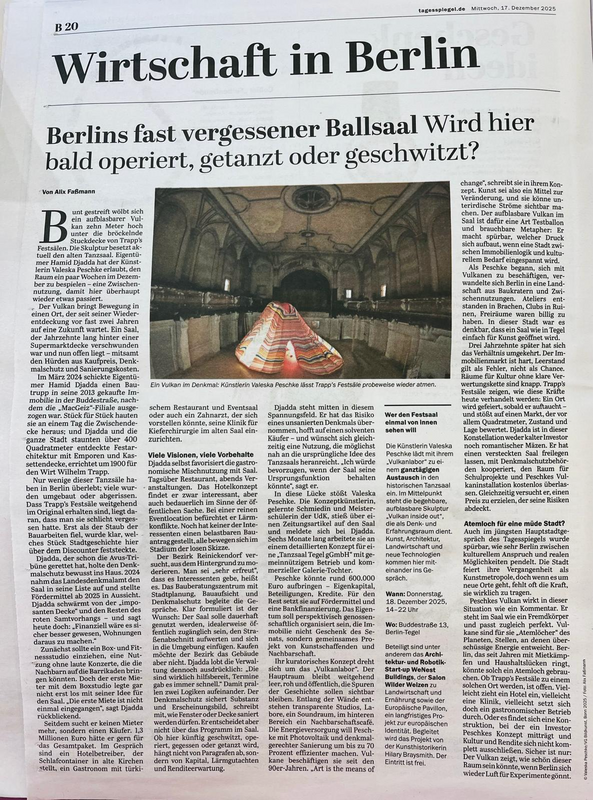
A colourful, striped inflatable volcano rises ten metres high beneath the crumbling stucco ceiling of Trapp’s Festsäle. The sculpture currently occupies the old ballroom. Owner Hamid Djadda has allowed the artist Valeska Peschke to use the space for a few weeks in December – a temporary use to get things happening here again. The volcano brings life to a place that has been waiting for a future since its rediscovery almost two years ago. A hall that had been hidden behind a supermarket ceiling for decades and now lies exposed – along with the hurdles of purchase price, listed building status and renovation costs. In March 2024, owner Hamid Djadda sent a construction crew to his property on Buddestraße, which he had bought in 2013, after the ‘MacGeiz’ branch had moved out. Bit by bit, they knocked out the false ceiling in a single day, and Djadda and the whole city marvelled at the 400 square metres of ballroom architecture they discovered, complete with galleries and coffered ceilings, built around 1900 for the innkeeper Wilhelm Trapp. Only a few of these ballrooms have survived in Berlin; many were converted or demolished.
The fact that Trapp’s ballrooms have largely been preserved in their original state is simply because they had been forgotten. It was only when the dust from the building work had settled that it became clear what piece of the city’s history lay hidden here above the discount store. Djadda, who had already saved the Avus grandstand, deliberately sought to have the building listed as a historic monument. In 2024, the State Office for the Preservation of Historical Monuments added the hall to its list and held out the prospect of funding from 2025 onwards. Djadda raves about the “impressive ceiling” and the remnants of the red velvet curtain – yet today he says: “Financially, it would certainly have been better to turn it into flats.”
Initially, a boxing and fitness studio was to move in – a use that wouldn’t involve loud concerts that might rile the neighbours. But the first tenant with the boxing studio never even got started with his idea for the hall. “The first rent payment hasn’t even come in,” says Djadda, looking back. Since then, he has stopped looking for a tenant and is now seeking a buyer. He would like 1.3 million euros for the whole package. Under discussion are a hotel operator who places sleeping pods in old churches, a restaurateur with a Turkish restaurant and event hall, and even a dentist who could envisage setting up his oral surgery clinic in the old hall.
Many visions, many reservations
Djadda himself favours a mixed-use catering concept with a function room: a restaurant by day, events in the evening. Whilst he finds the hotel concept interesting, he also considers it regrettable from a public interest perspective. He fears noise disputes if the site were to be used purely as an event venue. None of the interested parties has yet submitted a solid planning application; all are still at the stage of rough sketches. The Reinickendorf district is attempting to mediate from the background. They say they are “very pleased” that there are interested parties. The building advisory centre, comprising urban planning, building control and heritage conservation, is supporting the discussions. The wish is clearly stated: the hall should be used on a permanent basis, ideally be open to the public, enhance the street section and blend into the surroundings. However, the district does not wish to purchase the building.
Nevertheless, Djadda expressly praises the administration: “They are really helpful; appointments were always arranged quickly.” This brings two sets of priorities into conflict. The heritage protection authority safeguards the building’s fabric and appearance, and has a say in how windows or ceilings may be renovated. However, it does not decide on the programme for the hall. Whether people will be working out, undergoing surgery, eating or dancing here in future depends not on legal provisions, but on capital, noise assessments and expected returns. Djadda finds himself caught in the middle of this dilemma. He has taken on the risk of a monument in need of renovation, hoping for a solvent buyer – whilst at the same time wishing for a use that comes as close as possible to the original concept of the ballroom. “I would prefer it if the hall could retain its original function,” he says.
Valeska Peschke steps into this gap. The conceptual artist, a trained blacksmith and a master’s student of Rebecca Horn at the Berlin University of the Arts (UdK), came across the hall in a newspaper article and got in touch with Djadda. For six months, she worked on a detailed concept for a ‘Tanzsaal Tegel gGmbH’ – a non-profit organisation with a commercial gallery subsidiary. Peschke could raise around 600,000 euros – through equity, investments and loans. For the remainder, she is relying on grants and bank financing. The ownership is intended to be organised as a cooperative in the long term; the property is not a gift from the Senate, but a joint project between artists and the neighbourhood.
Her curatorial concept revolves around the “Vulkanlabor”. The main space will remain largely empty, raw and open to the public. The traces of history are to remain visible. Along the walls, transparent studios, laboratories and a sound room will be created, with a neighbourhood café at the rear. Peschke aims to make the energy supply up to 70 per cent more efficient through photovoltaics and renovation in line with heritage conservation standards. Volcanoes have fascinated her since the 1990s. “Art is the means of change,” she writes in her concept. Art, she argues, is a means of change and can make underground currents visible. The inflatable volcano in the hall serves as a kind of trial balloon and a useful metaphor: it makes tangible the pressure that builds up when a city is caught between property market logic and cultural needs.
When Peschke first began to explore volcanoes, Berlin was transforming into a landscape of construction craters and temporary uses. Studios sprang up on brownfield sites, clubs in ruins, and open spaces were cheap to come by. In this city, it was conceivable that a hall like the one in Tegel could simply be opened up for art. Three decades later, the situation has reversed. The property market is tough; vacant properties are seen as a mistake, not an opportunity; and spaces for culture without a clear commercial strategy are scarce. Trapp’s Festsäle demonstrate how these forces play out today: a venue is celebrated as soon as it appears – and encounters a market that values, above all, square metres, condition and location. In this constellation, Djadda is neither a cold-hearted investor nor a romantic patron. He has had a hidden hall uncovered, cooperated with heritage conservation authorities and made the space available free of charge for school projects and Peschke’s volcano installation. At the same time, he is trying to secure a price that covers his risks.
A breath of fresh air for a weary city?
In the Tagesspiegel’s latest ‘Capital City Talk’ too, it was clear just how much Berlin oscillates between cultural aspirations and practical realities. The city celebrates its past as an art metropolis, yet when it comes to new venues, it often lacks the strength to truly sustain them. In this context, Peschke’s ‘Vulkan’ seems like a commentary. It stands in the hall like a foreign object, yet fits perfectly. For her, volcanoes are the planet’s breathing spaces, places where excess energy escapes. Berlin, which has been grappling with rent disputes and budget shortfalls for years, could do with such a breathing space. Whether Trapp’s ballrooms will become such a place remains to be seen. Perhaps a hotel will move in, perhaps a clinic, perhaps a restaurant will prevail after all. Or perhaps a solution will be found where an investor supports Peschke’s concept and culture and profit are not entirely mutually exclusive. The only certainty is that the Volcano shows just how beautiful this space could be if Berlin were to allow itself room for experimentation once more.

For over 20 years, a supermarket occupied what was once a magnificent ballroom in Berlin-Tegel. Two years ago, the new owner restored the historic space to its former glory. The ballroom, built in 1900, is now a listed building and is set to be repurposed. Initial ideas for its future use are already in the pipeline.
This video is a report from rbb24 ABENDSCHAU #rbbabendschau
Report: Marvin Wenzel
Camera: Jan Rieger
Editing: Hanna Klinger
A supermarket for 20 years: is the forgotten function room being sold? - RBB24, February, 11. 2026. https://www.youtube.com/watch?v=VhA1m2H2N4g

Volcano Breath at Tanzsaal is a performative video work created in the Vulkanlabor at Tanzsaal Tegel, Berlin, and part of the ongoing performance series Volcano Breath. At the center of the work stands the inflatable volcano Inside Out by Valeska Peschke. The colorful, approximately five-meter-high sculpture rises in the space as a walk-in, breathing body, creating a temporary site for performative encounters. Like vents and airways of the Earth, it regulates the space, opening perspectives on interior and exterior, inviting reflection on concepts of home, borders, and transformation. In this sequence, the volcano is activated from within through the performance, voice, and sound of Anouk Lingk. Dance, singing, and sound editing intertwine with the cello played by Valeska Peschke, creating a multilayered soundscape. The audible breath of the volcano, the vastness of the sound, and its organic rhythm generate a space of longing, connection to the Earth, and living matter. The video presents Inside Out not only as a sculpture but as an activated, breathing, and sounding body within the ongoing Volcano Breath series.
Vulkan Atem (Vulcano Breath) - Performance Tanzsaal - Studio Valeska Peschke & Anouk Cécile Lingk. Mars, 14. 2026. https://www.youtube.com/watch?v=viTnaOEthNU
The art association Mitwelt, „Kunstverein Mitwelt“, was founded on May 28, 2026.
Chair: Valeska Peschke, Prof. Dr. Hilary Braysmith, n.n.
Contact: vorstand@kunstverein-mitwelt.org